About MYQORZO

Proven results

Actor portrayal.
Couple walking up steps

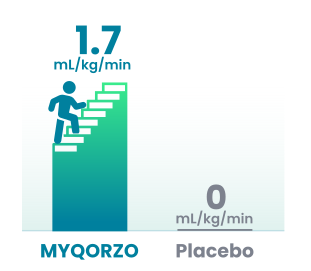
Proven to increase activity level

Average change in ability to be active (peak VO2) after 24 weeks*
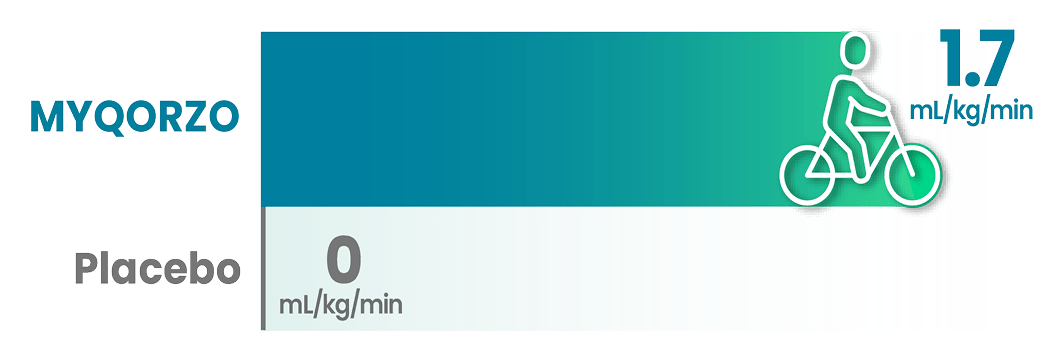
Change in exercise capacity after 24 weeks: Change in peak VO2 from where people started was 1.7 mL/kg/min with MYQORZO™ versus 0.0 mL/kg/min with placebo

A change of 1 mL/kg/min makes a clinically meaningful difference.

*Peak oxygen consumption (peak VO2) measures the amount of oxygen used by the body over a set time, based on body weight.

People who took MYQORZO vs placebo had a significant increase in the amount of physical activity they could do.

Learn about the clinical trial design.

Fast and lasting symptom improvement

MYQORZO reduced the day-to-day impact of symptoms, such as how tired or short-of-breath a person feels doing ordinary activities. Four NYHA ⓘ functional classes were used to measure the impact.

At 12 weeks, nearly 1 in 2 participants- 49% of those taking MYQORZO improved by 1 or more NYHA class vs 18% with placebo
At 24 weeks, nearly 3 in 25 participants - 59% of those taking MYQORZO sustained symptom improvement compared to baseline vs 24% with placebo

Fast and lasting reduced obstruction in the heart

MYQORZO reduced obstruction of blood flow out of the heart

As soon as 12 weeks, those taking MYQORZO had less obstruction
At 24 weeks, nearly 1 in 2- 49% of those taking MYQORZO had no meaningful obstruction vs 4% with placebo

Obstruction was measured by left ventricular outflow tract (LVOT) gradient ⓘ with a Valsalva maneuver ⓘ during an echocardiogram ⓘ.

Obstruction can make it harder for the heart to pump oxygen-rich blood to the body. It can result in symptoms like feeling tired or out of breath.

*Symptom-free=NYHA Class 1.

Levels below 30 mmHg.

Reduced the need for surgery by improving symptoms and obstruction

People in the clinical trial taking MYQORZO were ineligible for surgery an average of two times more days

Surgery=Septal reduction therapies such as septal myectomy and alcohol septal ablation. Surgery eligibility=Severe symptoms (NYHA Class III or IV) and severe obstruction (left ventricular outflow gradient ≥50 mmHg).

Improved symptoms and limitations, based on ratings from real people

Greater than two times improvement versus placebo

MYQORZO delivered 2x greater improvement in symptoms and limitations vs placebo, according to Kansas City Cardiomyopathy Questionnaire Clinical Summary Score ⓘ (KCCQ-CSS) ratings.

Over the 24-week clinical trial, average ratings improved 11.6 points with MYQORZO vs 4.3 with placebo.

Clinical trial design

A 24-week study of 282 adults compared MYQORZO with placebo.
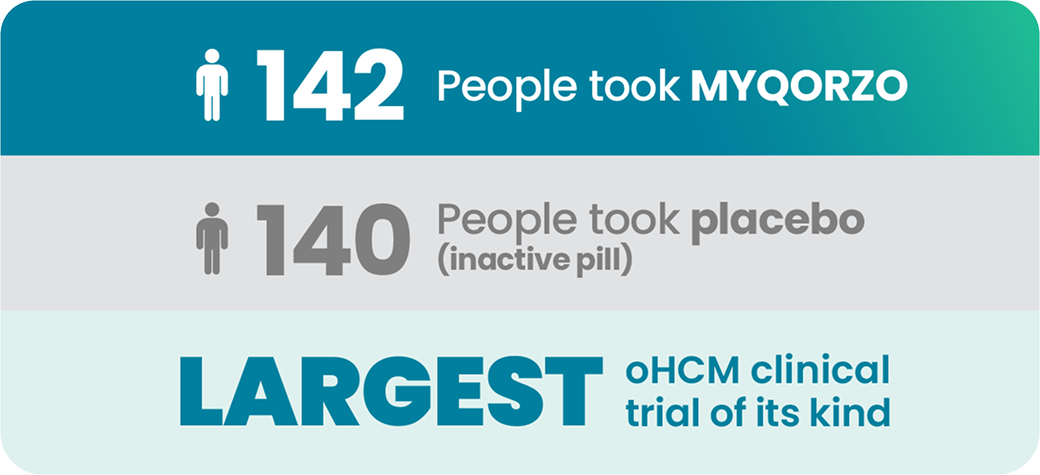
Two hundred and eighty-two participants were included in the clinical trial; one hundred and forty-two people taking MYQORZO, and one hundred and forty people taking placebo

Most participants (85%) were taking other medicines for obstructive HCM (beta blockers, calcium channel blockers, and/or disopyramide ⓘ).

>> In the clinical trial, high blood pressure was the only side effect reported by >5% of participants, including 8% of those taking MYQORZO and 2% on placebo.


IMPORTANT SAFETY INFORMATION

What is the most important information I should know about MYQORZO?

MYQORZO can cause serious side effects, including:

  • Heart failure, a condition where the heart cannot pump with enough force, is a serious condition that can lead to death. You must have echocardiograms (echos) before and during treatment with MYQORZO and monitor for signs and symptoms of heart failure. People who develop a serious illness such as a serious infection or who develop a new or worsening irregular heartbeat have a greater risk of heart failure during treatment with MYQORZO

    Tell your healthcare provider or get medical help right away if you develop new or worsening shortness of breath, chest pain, fatigue, leg swelling, a racing sensation in your heart (palpitations), or rapid weight gain.

  • The risk of heart failure is also increased when MYQORZO is taken with certain other medicines. Tell your healthcare provider about any prescribed and over-the-counter medicines you take, before and during your treatment with MYQORZO
  • Because of the risk of heart failure, MYQORZO is only available through a restricted distribution program called the MYQORZO Risk Evaluation and Mitigation Strategy (REMS) Program

    • Your healthcare provider must be enrolled in the MYQORZO REMS Program for you to be prescribed MYQORZO
    • Before you start treatment with MYQORZO, you must enroll in the MYQORZO REMS Program. Talk to your healthcare provider about how to enroll in the program. You will be given information about the program when you enroll
    • Before you take MYQORZO, your healthcare provider and pharmacist will make sure you understand how to take MYQORZO safely, which will include returning for echos when advised by your healthcare provider. MYQORZO can only be dispensed by a certified pharmacy that participates in the MYQORZO REMS Program
    • If you have any questions about the MYQORZO REMS Program, ask your healthcare provider, go to www.MYQORZOREMS.com, or call 1-844-285-7367

Who should not take MYQORZO?

Do not take MYQORZO if you take a medicine called rifampin.

What are the possible side effects of MYQORZO?

MYQORZO can cause serious side effects, including heart failure.

What should I tell my healthcare provider before taking MYQORZO?

Before taking MYQORZO, tell your healthcare provider about all of your medical conditions, including if you:

  • Are pregnant or plan to become pregnant. It is not known if MYQORZO can cause harm to your unborn baby. Tell your healthcare provider if you become pregnant during treatment or within 3 weeks after the last dose of MYQORZO. There is a pregnancy study for MYQORZO. Your healthcare provider should report your pregnancy exposure to Cytokinetics, Inc
  • Are breastfeeding or plan to breastfeed. It is not known if MYQORZO passes into your breast milk. Talk to your healthcare provider about the best way to feed your baby during treatment with MYQORZO

Before and during MYQORZO treatment, tell your healthcare provider about all the prescription and over-the-counter medicines, vitamins, and herbal supplements you take. Taking MYQORZO with certain medicines may lead to increased levels of MYQORZO in your blood and increase the risk of heart failure. Do not stop or change the dose of a medicine or start a new medicine without telling your healthcare provider.

Especially tell your healthcare provider if you take fluconazole (if used for more than 3 days), voriconazole, or fluvoxamine.

What are the most common side effects of MYQORZO?

The most common side effect of MYQORZO is high blood pressure (hypertension).

These are not all the possible side effects of MYQORZO. Talk to your healthcare provider for medical advice about side effects. You may report side effects to FDA at 1-800-FDA-1088. You may also report side effects to Cytokinetics at 1-833-633-2986.

INDICATION AND USAGE

MYQORZO is a prescription medicine used to treat adults with symptomatic obstructive hypertrophic cardiomyopathy (oHCM) to improve functional capacity and symptoms.

It is not known if MYQORZO is safe and effective in children.

Please see full Prescribing Information, including Boxed WARNING, and Medication Guide.